


UPVC Window Profile Mould Manufacturer China | Guide
2026-03-27 00:44How to Choose a Reliable UPVC Window Profile Mould Manufacturer in China
Over 410 million UPVC window frames were installed worldwide in 2024. Behind every single one of those profiles sits an extrusion mould that determined its dimensional accuracy, thermal chamber structure, and surface finish. For PVC window producers in Southeast Asia and the Middle East, finding the right UPVC window profile mould manufacturer in China is not just a procurement decision — it is a production lifeline.
Yet many overseas buyers hesitate. Concerns about quality consistency, communication gaps, and opaque manufacturing processes are common. This guide breaks down exactly what to look for, what to ask, and how to verify a Chinese mould supplier's capabilities — so you can make a confident, data-driven choice in 2026.
Why China Dominates UPVC Window Profile Mould Manufacturing
China's position in the global extrusion mould industry is no accident. It stems from three converging factors: scale, cost, and deepening technical expertise.
Market Scale Fuels Mould Innovation
China contributes roughly 49% of Asia-Pacific's UPVC window and door demand. That massive domestic market has created an ecosystem where mould manufacturers refine designs across thousands of production cycles every year. The result is a level of practical know-how that is difficult to replicate elsewhere.
A mature PVC window extrusion die supplier in China typically services both domestic profile producers and export clients simultaneously. This dual exposure sharpens their ability to handle diverse profile specifications — from 60mm casement systems to 80mm sliding frames with complex multi-chamber geometries.
Cost Advantage Without Sacrificing Quality
Compared to European or North American mould makers, Chinese factories offer 30–50% lower tooling costs on equivalent specifications. This gap is driven by lower labor costs, localized steel supply chains, and high factory utilization rates — not by cutting corners on materials or machining precision.
For a PVC window producer in Vietnam, Indonesia, or Saudi Arabia operating on tight margins, this cost difference can mean the difference between a profitable product line and an unviable one.
5 Critical Factors When Evaluating a UPVC Mould Manufacturer
Not all mould factories are equal. These five criteria separate dependable partners from risky suppliers.
1. Verified Industry Experience
Look for manufacturers with at least 15–20 years of dedicated extrusion mould experience. This is not an arbitrary number. UPVC window profiles demand tight tolerances — typically ±0.05 mm on wall thickness — and the know-how to achieve that consistently only comes from thousands of completed mould projects.
In our 20+ years of extrusion mould manufacturing at HZH Mold, we have found that the most common quality failures originate not from machining errors, but from flow channel design miscalculations that only experienced engineers can catch during the early design phase.
2. International Quality Certifications
Certifications are not just wall decorations. They provide a framework for process consistency. At a minimum, your custom UPVC profile mould factory should hold:
ISO 9001 — Quality management system covering design through delivery
IATF 16949 — Originally an automotive standard, this signals advanced process control capabilities that exceed basic requirements
These certifications ensure that the factory operates with documented procedures, statistical process control, and traceable quality records — not just ad-hoc craftsmanship.
3. Independent R&D and Design Capabilities
A reliable manufacturer should not simply copy your drawings. They should be able to optimize them. Advanced mould makers use intelligent CAD/CAM software and flow simulation tools to analyze melt distribution, pressure balance, and cooling uniformity before any steel is cut.
This capability is especially important for multi-chamber UPVC profiles, where uneven flow leads to wall thickness variation, internal chamber collapse, or surface defects that only appear after thousands of meters of production.
4. Complete After-Sales and Debugging Support
The mould delivery is only the halfway point. Proper debugging on your extrusion line is where the real value shows. Factors like screw speed, melt temperature, haul-off rate, and vacuum calibration all interact with mould performance.
The best suppliers provide on-site or remote debugging assistance, along with process parameter recommendations tailored to your specific extruder model and PVC formulation. Based on our engineering team's experience, roughly 60% of initial profile quality issues during startup are resolved through calibration adjustments — not mould modifications.
5. Export Track Record and Logistics Competence
A mould that arrives damaged or delayed disrupts your entire production timeline. Evaluate whether the factory has:
Established export packaging standards (wooden crates, rust-prevention treatment)
Experience with your target country's customs documentation
Proximity to international logistics hubs
For example, HZH Mold's facility is located just 10 km from Ezhou Huahu International Logistics Airport — one of Asia's newest cargo-focused airports — and 3 km from the Huangshi North Expressway entrance, ensuring rapid dispatch for China window mould export shipments.
Looking for a UPVC window profile mould manufacturer you can trust?
HZH Mold brings 20+ years of extrusion expertise, ISO 9001 & IATF 16949 certifications, and full-chain service from design to debugging.
Request a Free Mould Consultation →UPVC Window Profile Mould vs. Standard PVC Mould: Key Differences
Not every PVC extrusion mould manufacturer is qualified for UPVC window profiles. Here is why window moulds demand specialized expertise:
| Feature | Standard PVC Mould | UPVC Window Profile Mould |
|---|---|---|
| Chamber Structure | Single or dual cavity | Multi-chamber (3–6 chambers typical) |
| Wall Thickness Tolerance | ±0.10 mm | ±0.05 mm or tighter |
| Surface Finish Requirements | Functional | Decorative-grade (wood-grain, matte, gloss) |
| Co-extrusion Compatibility | Rarely needed | Often required (ASA/PMMA cap layer for UV) |
| Steel Grade | Standard tool steel | Premium alloy steel with nitriding treatment |
| Debugging Complexity | Low to medium | High (flow balancing across multiple chambers) |
This is precisely why generalist mould factories struggle with window profiles. The flow dynamics of distributing molten PVC evenly across 4 or 5 internal chambers while maintaining uniform wall thickness at high line speeds requires purpose-built design methodology and years of accumulated data.
What the Mould Manufacturing Process Looks Like
Understanding the production workflow helps you ask the right questions and set realistic timelines. Here is a typical process at a professional UPVC window profile mould manufacturer in China:
Profile Drawing Review & Optimization — Engineers analyze your cross-section drawings and suggest design improvements for manufacturability and performance
Flow Channel Simulation — CAD software models the melt flow path to ensure balanced distribution across all chambers
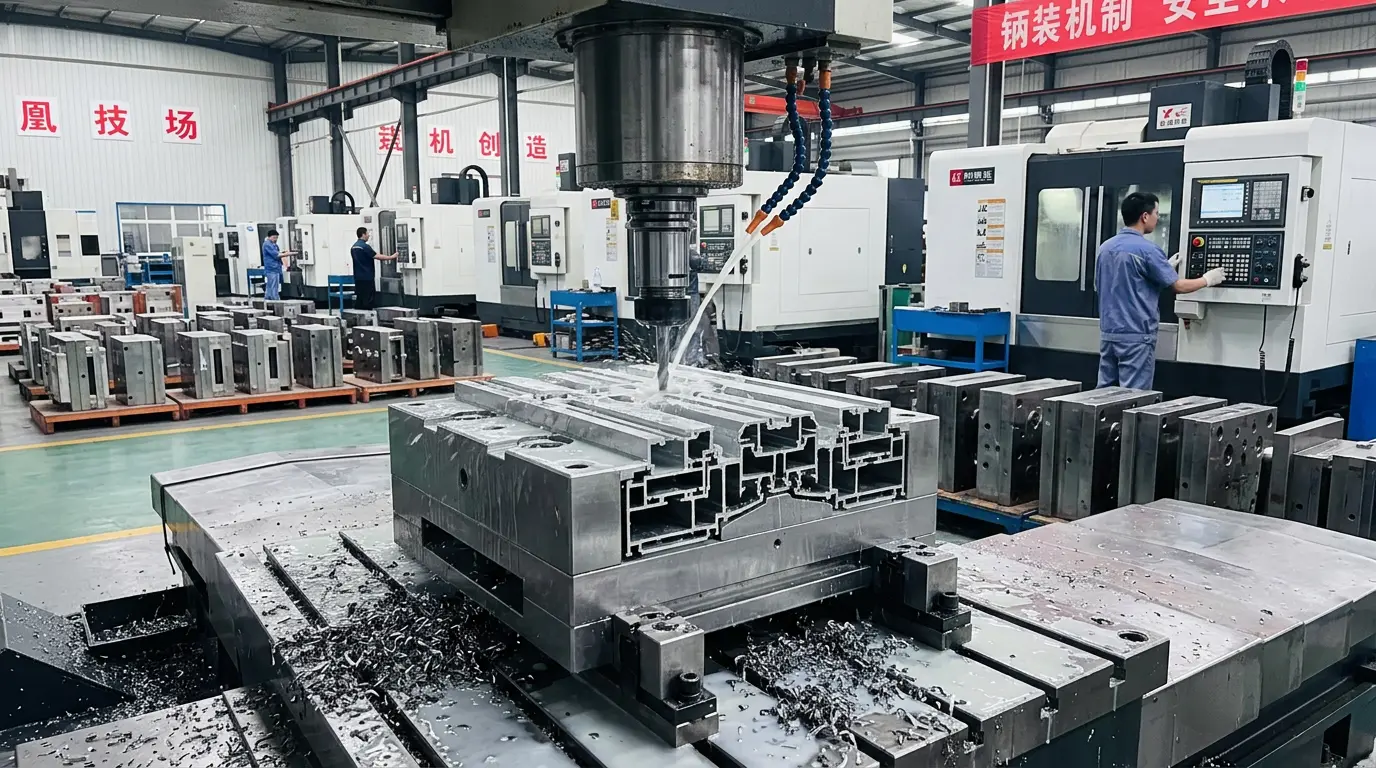
CNC Machining & Wire EDM — High-precision equipment shapes the die plates, mandrels, and calibration tooling
Heat Treatment & Surface Finishing — Nitriding and polishing extend mould life and improve profile surface quality
Assembly & Factory Testing — Complete mould assembly with preliminary trial runs where possible
Debugging Support — On-site or remote guidance during the first production run at your facility
Typical lead times range from 25–45 days depending on mould complexity and current production capacity. Multi-chamber window profile moulds generally fall toward the longer end of that range.
Regional Demand: Why Southeast Asia and the Middle East Need Reliable Mould Partners Now
The timing for securing a dependable PVC window extrusion die supplier has never been more urgent for these two regions.
Southeast Asia
Southeast Asia accounts for approximately 9% of Asia-Pacific's UPVC demand, and it is growing rapidly. Urban population growth across Vietnam, Indonesia, Thailand, and the Philippines is driving massive residential construction programs. Tropical climates make UPVC's moisture resistance especially valuable — extending service life beyond 20 years while reducing replacement frequency significantly compared to wood or basic aluminum.
Middle East
The Middle East combines extreme heat, sand exposure, and ambitious urban development. UPVC profiles with UV-stabilized formulations and multi-chamber thermal insulation are increasingly specified in government housing and commercial projects across Saudi Arabia, UAE, and Qatar. Energy-efficient building codes in these markets are accelerating UPVC adoption, creating sustained mould demand.
For profile manufacturers in both regions, partnering with a custom UPVC profile mould factory that understands regional climate requirements and can customize flow designs accordingly is essential for competitive product quality.
Quality Verification Checklist for Overseas Buyers
Before placing your order with any Chinese mould supplier, work through this practical checklist:
Request certification copies — ISO 9001 and IATF 16949 certificates should be current and verifiable
Ask for reference projects — Experienced factories can share non-confidential examples of moulds produced for similar profile types
Review equipment list — Look for CNC machining centers, wire-cut EDM machines, and precision grinding equipment
Evaluate communication quality — Technical accuracy in pre-sale responses indicates engineering depth
Confirm debugging policy — Written commitments to after-sales support are essential
Check logistics infrastructure — Proximity to major ports or airports reduces delivery risk
Key Takeaways
Specialization matters — UPVC window profile moulds require multi-chamber flow expertise, tight tolerances, and co-extrusion compatibility that general mould factories often lack
Certifications build confidence — ISO 9001 and IATF 16949 provide verifiable proof of process control, not just marketing claims
Full-chain service delivers value — The best manufacturers support you from design optimization through on-line debugging, reducing your startup risk significantly
As UPVC window demand accelerates across Southeast Asia and the Middle East in 2026 and beyond, the manufacturers who secure reliable, technically capable mould partners today will hold a decisive production advantage tomorrow.
Ready to discuss your UPVC window profile mould requirements?
HZH Mold offers 20+ years of extrusion mould expertise, international certifications, and complete R&D-to-debugging service for profile producers worldwide.
Get a Custom Quote Within 24 Hours →Frequently Asked Questions
What is a UPVC window profile extrusion mould?
A UPVC window profile extrusion mould is a precision steel tooling set that shapes heated PVC compound into window frame cross-sections with specific multi-chamber structures. The mould controls wall thickness, chamber geometry, and surface finish. It consists of a die head, mandrel, and vacuum calibration sleeve that work together to produce dimensionally accurate profiles continuously.
How long does it take to manufacture a custom UPVC window mould in China?
Typical lead times for a custom UPVC window profile mould range from 25 to 45 days, depending on profile complexity, number of chambers, and co-extrusion requirements. Multi-chamber casement or sliding window moulds generally require 35–45 days. Simpler single-system moulds may be completed in 25–30 days. Rush orders may be accommodated with advance scheduling.
What certifications should a Chinese mould manufacturer hold?
At minimum, look for ISO 9001 certification for quality management systems. IATF 16949 indicates advanced automotive-grade process control, which translates directly to tighter tolerances and better documentation. Industry-specific credentials such as the Jinwei Global Extrusion Engineer Certification further validate hands-on technical competence in extrusion die design.
Can Chinese mould manufacturers provide on-site debugging support?
Yes, experienced manufacturers like HZH Mold provide both on-site and remote debugging services. This includes extrusion parameter optimization, vacuum calibration adjustments, and haul-off speed tuning. Debugging support is critical because roughly 60% of initial quality issues during mould startup relate to process settings rather than mould design itself.
Why choose China over European mould suppliers for UPVC window dies?
Chinese manufacturers typically offer 30–50% lower tooling costs compared to European equivalents at comparable quality levels. Factories with ISO and IATF certifications use the same steel grades and CNC machining processes. Additionally, China's proximity to Southeast Asian and Middle Eastern markets reduces shipping time and logistics costs significantly.