


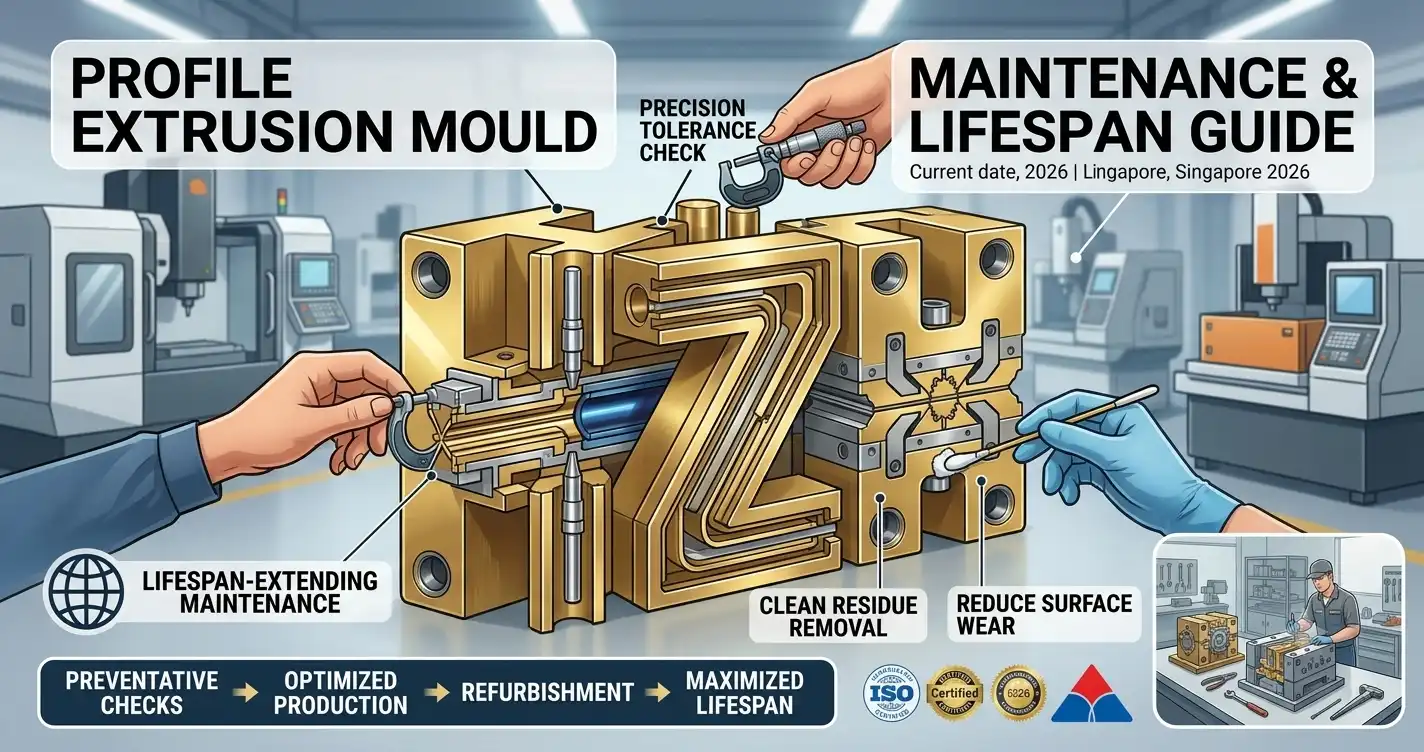
Profile Extrusion Mould Maintenance & Lifespan Guide
2026-07-25 22:20Profile Extrusion Mould Maintenance and Lifespan: What Every Production Manager Needs to Know in 2026
A door or window profile extrusion mould that cost USD 2,400 and was supposed to last 400 tonnes of production starts showing dimensional drift at 180 tonnes. Surface finish degrades. Wall thickness variation increases beyond tolerance. Scrap rates climb. And the supplier who was responsive before the order is suddenly hard to reach.
This scenario is not rare. It is the single most common complaint from production managers and maintenance engineers across global profile extrusion operations — and it is almost always the result of two compounding failures: inadequate maintenance during service and insufficient after-sales support commitment from the supplier.
This guide gives production managers and equipment maintenance teams a practical, technically grounded framework for extending profile extrusion mould maintenance and lifespan — covering the wear mechanisms that shorten die life, the maintenance interventions that counteract them, the monitoring schedule that catches problems before they become scrap crises, and the after-sales service standards that a qualified mould supplier should be meeting right now.
What Actually Wears Out in a Profile Extrusion Die — and Why
Understanding wear mechanisms is the foundation of effective die maintenance. A profile extrusion die does not fail randomly. It wears in predictable locations, through predictable mechanisms, at rates that are largely controllable through maintenance practice and operating discipline.
The Three Primary Wear Mechanisms
1. Abrasive Wear at Die Exit Surfaces
The die land — the final forming zone where molten material exits the die — experiences the highest mechanical contact stress of any die component. For PVC and UPVC profiles, calcium carbonate filler particles (typically 5–15 phr in window profile formulations) act as an abrasive medium against the die land surface with every kilogram of material processed. For WPC profiles, wood fiber particles are significantly more abrasive. Die land wear produces progressive surface roughening that first degrades profile gloss and surface quality before advancing to dimensional inaccuracy as the land geometry itself erodes.
2. Corrosive Attack from PVC Off-Gases
Rigid PVC — including UPVC window and door profile compounds — releases hydrogen chloride (HCl) gas during processing at temperatures above 160°C. HCl is corrosive to unprotected steel surfaces, attacking flow channel walls and die face surfaces over time. Nitriding treatment creates a corrosion-resistant surface layer that dramatically slows this attack — but nitriding has a service life of its own, and a die running PVC without periodic nitriding re-treatment will eventually expose base steel to accelerating corrosive degradation.
3. Thermal Fatigue at High-Stress Geometry Points
Die components experience repeated thermal cycling — heating during production, cooling during shutdown — that creates cumulative thermal fatigue stress, particularly at sharp internal corners, thin mandrel walls, and porthole bridge sections. Over time, this produces micro-cracking that progresses to surface crazing and eventually to structural failure of critical die components. H13 hot-work tool steel resists thermal fatigue significantly better than P20 or carbon steels — which is why steel specification at purchase is the most important long-term maintenance decision.
How to Monitor Die Condition: The 4-Level Inspection System
Reactive maintenance — waiting until profile quality problems are visible before inspecting the die — is the most expensive approach to how to extend extrusion die life. By the time scrap rates increase measurably, die wear has typically progressed to a point requiring either significant correction work or premature replacement.
A structured 4-level inspection system catches wear progression at each stage — when intervention is cheapest and least disruptive to production continuity.
Level 1: Production Shift Monitoring (Daily)
Production operators should log these parameters at the start of each shift and at 4-hour intervals during continuous runs:
Profile weight per metre — a consistent increase indicates wall thickness growth from dimensional drift; decrease indicates thinning or flow restriction
Surface gloss rating — visual comparison against a reference sample kept at the line identifies progressive surface finish degradation before it reaches customer-visible severity
Extrusion pressure at constant line speed — rising back-pressure at unchanged process settings indicates flow channel restriction from material build-up or geometric change
Profile straightness check — a 2-metre straightedge check on the first and last profile of each shift identifies the developing bow or twist that precedes dimensional non-conformance
Level 2: Weekly Dimensional Inspection
Every 5–7 production days, a sample of 10 profiles from each active die position should be dimensionally measured against the original profile drawing tolerances using calibrated measuring equipment. Critical dimensions to monitor:
Overall profile width and height at three points along a 300 mm sample length
Wall thickness at all specified measurement points in the cross-section
Chamber internal dimensions (for multi-chamber profiles)
Gasket groove or hardware slot width and depth
Log results in a dimensional trend chart. Progressive drift in any dimension — even if still within tolerance — indicates active wear and allows maintenance intervention timing to be planned without production disruption.
Level 3: Monthly Die-Off Inspection
Once per month, schedule a planned die removal for direct inspection of the die components. With the die off the line and cleaned of material residue:
Visually inspect die land surfaces under magnification (10×) for surface roughening, micro-pitting, or corrosion evidence
Measure die land dimensions directly against original engineering drawings
Inspect flow channel surfaces for material degradation deposits, particularly at corners and in low-flow zones where residence time is highest
Check mandrel and spider leg surfaces for thermal cracking evidence
Test surface hardness at die land and flow channel areas — a significant drop from the post-nitriding baseline (typically 900–1,050 HV) indicates nitriding layer depletion
Level 4: Semi-Annual Supplier Assessment
Every six months — or at the cumulative production volume thresholds discussed below — send the die to the manufacturer for a formal condition assessment. A professional door window mould after-sales service provider performs a complete dimensional survey against original drawings, surface hardness mapping, and a written condition report recommending specific maintenance interventions with projected cost and lead time.
The Maintenance Intervention Toolkit: What Works and When
Once inspection data identifies wear progression, the appropriate maintenance intervention depends on wear type, severity, and the die's remaining service life budget. These five interventions cover the full range of situations production managers encounter.
1. Flow Channel Re-Polishing
When to apply: Surface roughness of flow channels has increased measurably, profile surface quality has degraded, or material build-up deposits are visible on flow channel walls during monthly inspection.
What it involves: The die is disassembled and flow channel surfaces are polished back to the original Ra specification — typically Ra 0.4–0.8 μm for PVC profile dies — using progressively finer abrasive media under controlled conditions. Re-polishing restores flow characteristics, eliminates degradation deposit nucleation sites, and extends surface quality life by 50–150 additional tonnes depending on wear severity at intervention.
Lead time: 5–10 days depending on die complexity. Can be performed locally by qualified toolmakers or returned to the original manufacturer.
2. Die Land Correction and Re-Grinding
When to apply: Dimensional drift in profile cross-section dimensions has reached 40–60% of tolerance budget — ideally before non-conforming profiles are produced, not after.
What it involves: Worn die land sections are precision-ground to restore original geometry, with bearing length recalculation if wear has altered flow characteristics. For localised wear at specific profile sections, spot-correction grinding can restore dimensional accuracy without full die rework.
Important constraint: Die land correction is only feasible while sufficient material thickness remains above the original land dimension. Dies run to severe wear without intervention eventually reach a point where correction requires new die plates — a full rework cost rather than a maintenance cost. Early intervention is always less expensive.
3. Nitriding Re-Treatment
When to apply: Surface hardness measurement shows depletion below 700 HV (from the original post-nitriding baseline of 900–1,050 HV), or corrosive attack evidence is visible on PVC-contact surfaces during monthly inspection.
What it involves: The die components are re-nitrided using the same process applied during original manufacture — gas nitriding or salt bath nitriding — restoring the protective hard surface layer to original specification. Re-nitriding extends corrosion and abrasion resistance for a further 150–300 tonnes of production depending on compound abrasivity.
4. Replaceable Insert Renewal
When to apply: Localised wear or damage at high-stress die exit sections — particularly die lip areas and mandrel tips — where the affected section is designed as a replaceable insert rather than an integral die component.
What it involves: The worn insert is removed and replaced with a new precision-machined component, restoring die exit geometry without any intervention to the primary die body. This approach is most cost-effective when the original die was designed with modular insert architecture — another reason to specify modular construction at purchase rather than treating it as an optional feature.
Lead time from a prepared supplier: 7–15 days for a standard insert type held in stock by the manufacturer. This is where the supplier's spare parts policy becomes operationally critical — a 45-day insert lead time on a high-volume die position creates a production crisis that a 10-day response prevents.
5. Full Die Rework or Replacement Assessment
When to apply: Cumulative wear has depleted the correction and re-nitriding margin, dimensional accuracy cannot be restored within the remaining die material, or thermal fatigue cracking has advanced to structural risk in critical die components.
Decision framework: A professional condition assessment from the original manufacturer should provide a written comparison of rework cost versus new die cost, with a projected post-rework service life estimate. If rework cost exceeds 60% of new die cost and post-rework life is projected at less than 50% of original service life, new die manufacture is typically the better economic decision.
After-Sales Service Standards: What Your Mould Supplier Should Be Delivering
The maintenance interventions above are only executable if your mould supplier provides the service infrastructure to support them. For production managers evaluating their current supplier relationship — or procurement teams selecting a new one — these are the specific after-sales service standards that a professional door window mould after-sales service provider delivers in 2026.
Response Time Commitments
| Service Request Type | Professional Standard | Unacceptable Response |
|---|---|---|
| Technical query (email/chat) | Same business day response | 48+ hours with no acknowledgement |
| Remote debugging request | Scheduled within 24 hours | No video support capability offered |
| Condition assessment request | Written report within 5–7 days of die receipt | Verbal assessment only, no documentation |
| Standard correction round | 7–14 days turnaround | 25+ days with no progress updates |
| Replacement insert dispatch | 5–10 days for standard types | "We need to machine it from scratch" for basic inserts |
| Re-nitriding service | 8–12 days including transit | No re-nitriding service offered post-sale |
Documentation That Should Accompany Every Service Intervention
Every maintenance service — whether re-polishing, die land correction, re-nitriding, or insert replacement — should generate a written service record that becomes part of the die's permanent maintenance file. This documentation serves three functions: it provides evidence that the intervention was performed to specification, it creates the historical data needed for future maintenance interval planning, and it supports warranty claims if post-service performance falls short of committed targets.
At minimum, each service record should include:
Die identification number and cumulative production tonnage at service date
Dimensional condition before intervention — key measurements against drawing tolerances
Specific interventions performed — materials used, processes applied, equipment employed
Post-intervention dimensional verification — CMM or equivalent measurement confirming restoration to specification
Projected next maintenance interval based on observed wear rate and intervention performed
Engineer sign-off with name and qualification
The Spare Parts Inventory Commitment
A professional mould manufacturer retains critical spare components for every die they have sold for a defined post-sale period — typically five to seven years from original delivery. This inventory should include at minimum:
Replaceable die lip inserts and mandrel tip inserts
Spider leg and porthole bridge sections for complex hollow profiles
Calibration sleeve liners and vacuum slot inserts for the sizing tooling
Any hardware-specific components unique to the profile geometry
Confirm spare parts availability policy before placing any mould order. A supplier who cannot commit to spare parts availability for a defined post-sale period creates production vulnerability that emerges precisely when production pressure is highest — during a breakdown requiring fast component replacement.
Concerned about the remaining service life or maintenance support for your current profile dies?
Huazhiheng Mold provides die condition assessments, re-polishing, nitriding re-treatment, correction services, and documented maintenance programmes for both our own tooling and dies sourced from other manufacturers — backed by 20+ years of extrusion die engineering expertise and ISO 9001 & IATF 16949 certified service processes.
Request a Die Condition Assessment →Maximising Lifespan Through Operational Discipline: 6 Production Practices That Matter
Maintenance interventions restore die condition. Operational discipline slows the wear rate that makes interventions necessary. These six practices — all within the production manager's direct control — have measurable impact on die service life.
Purge the die before every planned shutdown. Material residue left in a PVC die during a shutdown continues releasing HCl gas as it slowly degrades — accelerating corrosive attack on flow channel surfaces. A 10-minute purge with a neutral purging compound before shutdown eliminates this between-run damage accumulation
Never exceed the die's designed maximum extrusion temperature by more than 5°C. Elevated melt temperature increases HCl release rate from PVC, accelerates corrosive attack, and reduces viscosity in ways that increase shear stress on flow channel surfaces. Temperature discipline directly extends nitriding layer life
Store idle dies in a climate-controlled environment with VCI (Vapour Corrosion Inhibitor) film protection. Dies stored in humid, uncontrolled environments develop surface corrosion within weeks that requires re-polishing before the die can return to service. Proper storage costs nothing and prevents a recurring maintenance expense
Clean dies with approved solvents only — never mechanical scraping on flow surfaces. Mechanical scraping with steel tools on die land and flow channel surfaces removes nitriding layer material with every cleaning cycle. Approved solvent cleaning or controlled ultrasonic cleaning preserves surface treatment integrity
Monitor and control filler loading in your PVC compound. Every additional 5 phr of CaCO₃ filler increases die land abrasion rate measurably. If your compound formulation changes — even within the same supplier's product range — notify your mould engineer to assess whether maintenance intervals need adjustment
Record and report every unexpected process anomaly immediately. Sudden pressure spikes, unusual profile distortion, or unexplained dimensional shifts are early warning signals of die damage or wear acceleration — not normal process variation to be adjusted around. Immediate reporting enables early intervention before progressive damage compounds
Key Takeaways
Die wear is predictable and manageable — abrasive wear at die land surfaces, HCl corrosion of PVC-contact steel, and thermal fatigue at stress concentrations are the three mechanisms that limit service life, and all three respond to the combination of correct specification at purchase, operational discipline during service, and scheduled maintenance intervention before damage becomes irreversible
A 4-level inspection system — daily shift monitoring, weekly dimensional sampling, monthly die-off inspection, and semi-annual supplier assessment — converts die maintenance from reactive crisis management to planned production cost, reducing total maintenance expenditure by 40–60% over a five-year production horizon
After-sales service is a contractual requirement, not a relationship courtesy — response time commitments, written service documentation, condition assessment capability, and spare parts inventory are the minimum standards that a professional mould supplier should meet as documented obligations, not best-effort intentions
In 2026's profile extrusion market, production managers who implement structured die maintenance programmes consistently outperform those who manage tooling reactively — in scrap rate, production uptime, total tooling cost per tonne of output, and supplier relationship quality. The framework in this guide is the starting point for building that advantage.
Ready to establish a structured maintenance programme for your profile extrusion dies?
Huazhiheng Mold provides complete die lifecycle support — condition assessment, re-polishing, nitriding re-treatment, correction rounds, spare insert supply, and documented maintenance scheduling — for door and window profile dies worldwide. ISO 9001 & IATF 16949 certified service processes with written documentation at every intervention stage.
Build Your Die Maintenance Programme Today →Frequently Asked Questions
How long should a UPVC window profile extrusion mould last?
A correctly specified UPVC window profile mould — P20 nitrided tool steel for standard production, H13 vacuum-hardened and nitrided for high-volume operations — should last 250–400 tonnes and 400–700 tonnes respectively under well-maintained conditions. Service life is determined by steel specification at purchase, compound abrasivity (filler loading), operating temperature discipline, and maintenance intervention timing. Dies run without scheduled maintenance typically reach their wear limit at 50–60% of their specification potential.
When should a profile extrusion die be re-nitrided?
Re-nitriding intervals depend on the compound being processed: standard UPVC (low filler) every 250–350 tonnes; high-fill UPVC (15+ phr CaCO₃) every 150–200 tonnes; WPC compounds every 80–120 tonnes. Surface hardness measurement during monthly die-off inspection provides the most accurate trigger — re-nitriding is indicated when surface hardness drops below 700 HV from the post-treatment baseline of 900–1,050 HV. Waiting for visible corrosion evidence means the intervention is already overdue.
What causes premature dimensional drift in a profile extrusion die?
The four most common causes of premature dimensional drift are: under-specified steel grade (45# carbon steel instead of P20 or H13); absent or depleted nitriding treatment exposing base steel to accelerated PVC corrosion; operating temperature above design range increasing corrosive HCl release; and excessive filler loading in the PVC compound beyond the compound specification used for original die design. Each cause produces a different wear pattern — surface hardness mapping during monthly inspection identifies which mechanism is active.
Can a profile extrusion mould from another manufacturer be serviced and maintained by Huazhiheng Mold?
Yes. Huazhiheng Mold provides die condition assessment, re-polishing, nitriding re-treatment, and correction services for profile extrusion dies regardless of original manufacturer. The process begins with a dimensional condition assessment against the original profile drawing — which the client provides — followed by a written service proposal covering recommended interventions, cost, and projected post-service life. ISO 9001 and IATF 16949 certified service processes apply to all third-party die maintenance work.
What is the correct way to store a profile extrusion die when not in use?
Correct die storage requires: complete removal of all material residue using approved solvents (never mechanical scraping); application of rust-preventive oil to all machined surfaces; wrapping in VCI (Vapour Corrosion Inhibitor) film to prevent atmospheric corrosion; and storage in a climate-controlled environment at 15–25°C with relative humidity below 60%. Dies stored correctly between production campaigns can remain in service-ready condition for 12–24 months without requiring re-polishing before recommissioning.