


Understanding the Basics: What is an Extrusion Die?
If you work with plastic profiles—or you’re evaluating suppliers for a new product—you’ve likely heard the term “extrusion tooling” used as shorthand for the heart of the process: the die. This guide breaks down how it works, what’s inside, and why design details matter so much to output, appearance, and long-term stability.
Extrusion, at its core, is about turning melted material into a consistent, continuous shape. If you’re asking what is an extrusion, think of it as a controlled flow problem: plastic is heated until it becomes a uniform melt, then pressure pushes it forward through a shaped opening. When it exits, you get a long, continuous profile (often called an extrudate) that can be cooled, sized, and cut into whatever length your application needs.
The range of products is huge: pipes, tubing, weatherstrips, decking components, window/door profiles, cable management, protective trims, and even the occasional prototype extruded plastic dingus that exists purely to prove a concept before committing to a full production part.
Talk to the Experts
Zhongjie is a well-known Chinese manufacturer focused on extrusion tooling and precision machining for polymer processing. If you’re developing a new profile, troubleshooting output issues, or looking to shorten lead times without sacrificing consistency, the Zhongjie team can help you map out a practical path from drawing to stable production.
Tip: Sharing your target material, wall thickness range, expected line speed, and critical tolerances upfront typically saves time during design review.
Explore related tooling:
These links are helpful starting points if you’re comparing configurations, materials, or typical applications.
What is an Extrusion Die
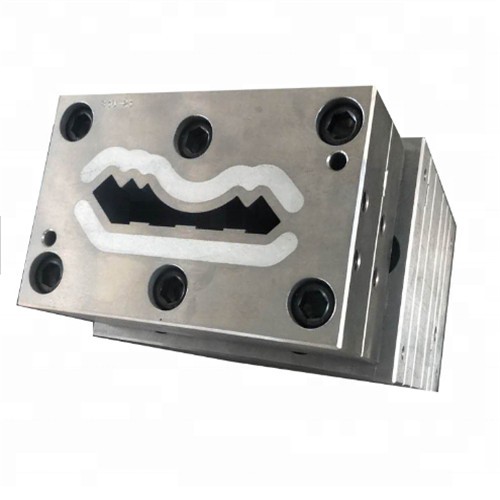
An extrusion die is the forming tool that turns molten polymer into a specific cross-sectional shape. In simple terms, it decides what your profile looks like, how uniform the wall thickness stays, and how stable your dimensions remain over time and speed changes.
While it’s tempting to think of a die as “just a shaped hole,” real-world performance depends on flow behavior. Channel geometry, surface finish, land length, and transitions all influence how evenly the melt fills the profile. A well-designed die helps the line run smoother, reduces scrap, and makes quality control far less dramatic.
Key components you’ll typically see
Most assemblies are built from robust tool steels or stainless steels chosen to handle heat, pressure, and wear. Exact selections depend on polymer type, filler content, and expected production volume.
Adapter plate: Connects the tooling to the extruder. It often interfaces with a breaker plate and helps convert rotational melt movement into a more uniform forward flow.
Transition plates: These plates reshape the melt stream from a circular inlet toward the final profile geometry. Depending on complexity, you may have one plate or several. Their job is to guide flow smoothly and prevent “dead zones” or uneven filling.
Die plate: Contains the final shaping geometry. This is where the profile’s cross-section is defined in detail.
Die land: A straight section after the shaped region that stabilizes flow and helps lock in dimensions before the material exits.
Die lips: The exit edges that influence final dimensions and surface finish as the melt leaves the tool and begins to cool.
Hollow profiles: spider plate and mandrel support
When the profile needs an internal void—like a round tube or a multi-chamber shape—the tooling often uses a spider-style support. The spider’s legs distribute material around a center mandrel (or pin), creating the hollow section while keeping flow as balanced as possible. Done well, you get consistent wall thickness and stable sizing downstream.
Process control features
Depending on the product and line setup, tooling may also include heaters, cooling channels, and sensor provisions. These details aren’t “nice to have.” They can be the difference between an output that holds tolerance for hours and one that drifts every time ambient conditions change.
Co-extrusion and tri-extrusion considerations
For multi-material parts, internal flow dividers keep layers separated until just before exit. Divider design is a balancing act: too short and materials mix early (hurting layer control); too long and bonding suffers. The aim is a clean interface with reliable adhesion, without one material overpowering or blocking the other in the final approach to the exit.
Practical shop-floor note: if you’re training a new team member and they ask what is an extrusion operator, the best answer is “the person who keeps the line stable.” The operator’s ability to read melt behavior, temperature trends, and dimensional feedback is just as important as the tooling itself.
Challenges with Making A Die
Building tooling that “works” is not the same as building tooling that runs at target speed, holds tolerance, and produces a clean surface consistently. The most common performance bottleneck is the transition design—the section that takes melt flow from a round extruder outlet to a wide, thin, or complex profile.
1) Balanced flow is everything
As profiles get wider or more detailed, flow naturally favors shorter, easier paths. Material farther from the center tends to lag, which can cause thickness variation, poor corner fill, or surface instability. Transition geometry must compensate by streamlining paths and balancing resistance so each zone receives the right amount of melt.
Unbalanced filling can show up as dimensional drift across the width of the profile.
Surface issues often trace back to inconsistent velocity, shear, or localized overheating.
Output limitations (can’t hit line rate) are frequently caused by unnecessary restriction or poor distribution.
2) Streamlining vs. manufacturability
Ideal flow channels are smooth and gradual, but they must also be practical to machine, polish, and maintain. A design that looks perfect in CAD can become a headache if it’s difficult to clean, sensitive to small wear changes, or requires constant adjustment to stay within spec.
3) Geometry limits: thin walls, sharp corners, and spacing
Some shapes are simply harder to run than others—especially when you combine thin sections with tight tolerances. In many applications, extremely thin walls (for example, below 0.20") and sharp internal corners increase risk: they encourage uneven filling, make cooling less forgiving, and amplify sensitivity to minor process swings.
Spacing between walls also matters. If chambers are too close, the melt may not distribute evenly, and downstream sizing can become unstable. What’s acceptable depends on part size, polymer type, filler content, and how the line is cooled and calibrated.
4) Maintenance and wear considerations
Even a great design will degrade if it’s not maintained. Lips wear, surfaces pick up damage during cleaning, and small imperfections can translate into visible streaks or dimensional variation. Designing for maintainability—reasonable access, repeatable alignment, and serviceable components—pays off over the tool’s life.
Work With The Extrusion Die Experts
Zhongjie builds extrusion tooling in-house, which helps shorten communication loops between design, machining, finishing, and quality checks. That matters because the “last 10%” of details—surface finish, alignment, flow balance, and practical serviceability—often determines whether a tool is easy to run or a constant source of downtime.
The goal is straightforward: tooling that supports stable output, repeatable dimensions, and a surface appearance that matches your market expectations. Whether you’re producing commodity profiles at high speed or more demanding parts where fit-and-finish matters, the right design approach will reduce scrap and help the line reach its intended rate.
What you can expect when you engage Zhongjie
Design aligned to production reality: flow balance, tolerance control, and practical geometry choices.
Machining and finishing discipline: materials and processes selected to support wear resistance and clean surfaces.
Support for multi-material profiles: divider and channel strategies that protect layer structure and bonding.
Clear communication: fewer handoffs and more direct feedback between engineering and manufacturing.
Summary
A well-performing die is not defined only by the final opening shape—it’s defined by how smoothly and evenly the polymer is guided there. Transition design, balanced flow paths, land geometry, and maintainability all influence whether your line runs cleanly at speed and holds the tolerances your customers expect.
If you’re planning a new profile or troubleshooting a current one, Zhongjie can help you evaluate the design constraints early, choose a tooling approach that fits your material and output goals, and move from drawing to stable production with fewer surprises.
FAQ
What products can be made with extrusion?
Common examples include pipes, tubing, sheets, trims, seals, cable channels, decorative profiles, and many custom cross-sections used in construction and industrial applications.
Why do some profiles drift in size during long runs?
Dimensional drift can come from temperature shifts, unstable melt flow, uneven cooling, wear at the exit region, or an imbalance in distribution inside the tooling. A process review plus a tooling inspection is usually the fastest way to isolate the root cause.
Is co-extrusion mainly for appearance?
Appearance is one benefit, but co-extrusion is also used for function: combining a rigid base with a softer sealing layer, improving weather resistance, adding a cap layer for durability, or optimizing cost by placing premium material only where needed.
What information helps speed up tooling evaluation?
A drawing (or sample), target polymer and additives, wall thickness range, expected line speed, tolerance priorities, and any known defects or pain points from current production.