


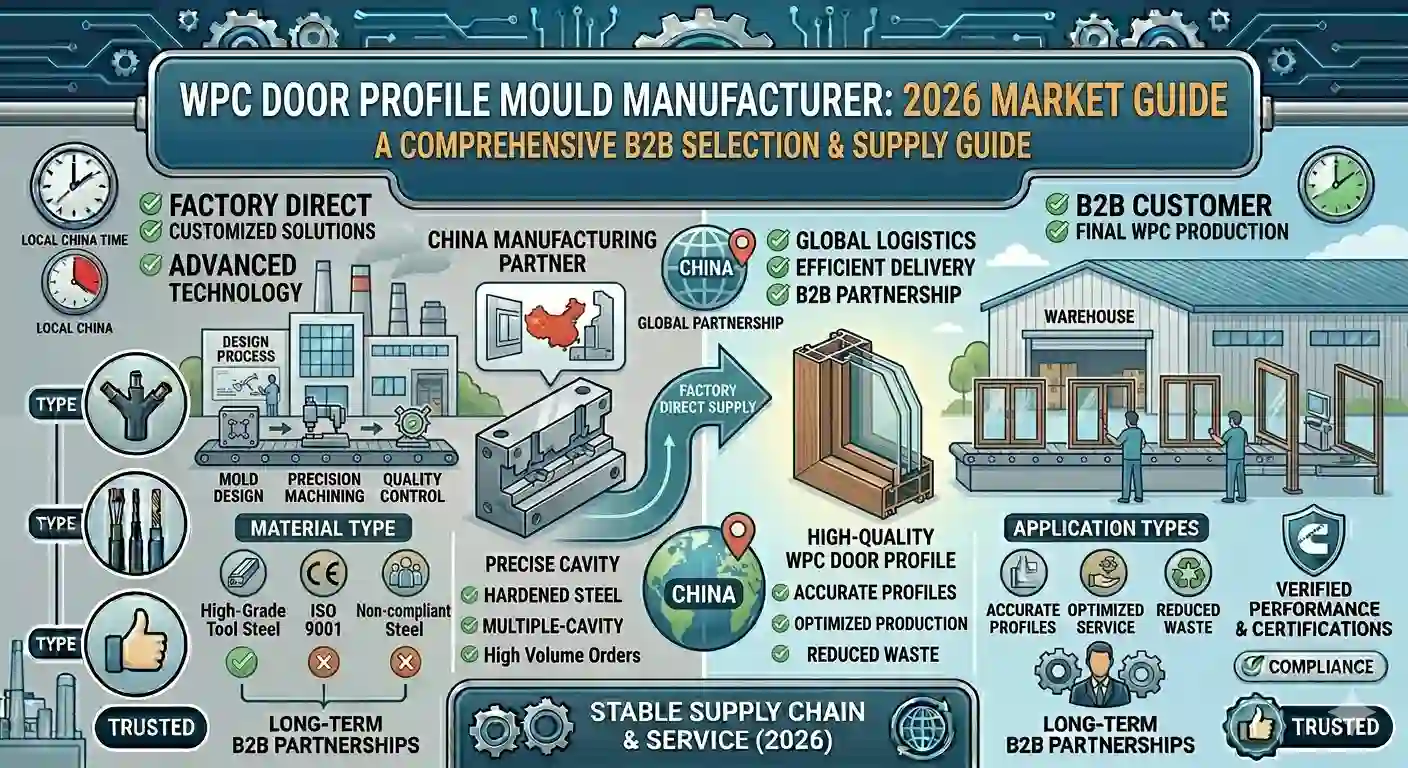
WPC Door Profile Mould Manufacturer: 2026 Market Guide
2026-04-25 00:28WPC Door Profile Mould Manufacturer: Why 2026 Is the Right Time to Enter the Wood Plastic Composite Market
Across Southeast Asia and sub-Saharan Africa, a quiet but accelerating shift is reshaping the door and window market. Timber is getting scarcer and more expensive. PVC carries growing regulatory scrutiny in green building specifications. And architects, developers, and homeowners are increasingly demanding materials that look natural, last longer, and carry a credible environmental story.
Wood Plastic Composite (WPC) door profiles are filling that gap — faster than most building materials distributors realize. The global WPC market was valued at approximately USD 6.8 billion in 2025 and is projected to exceed USD 11 billion by 2030, growing at a CAGR of over 9% (Grand View Research, 2025). Door and window profiles represent one of the fastest-expanding application segments within that growth curve.
For building materials distributors, green construction procurement teams, and entrepreneurs entering the door profile manufacturing space, understanding WPC — and the WPC door profile mould manufacturing process behind it — is the first step toward capturing a share of this expanding market.
What Is WPC and Why Is It Replacing Traditional Door Materials?
Wood Plastic Composite is a hybrid material combining wood fiber or wood flour (typically 50–70% by weight) with thermoplastic polymers — most commonly HDPE, PVC, or PP — along with stabilizers, lubricants, and UV-resistant additives. The result is a material that behaves like engineered wood during installation but performs like a polymer in service.
The Performance Case Against Timber and Standard PVC
Traditional timber door frames face serious performance limitations in tropical and high-humidity climates across Southeast Asia and coastal Africa. Moisture absorption causes swelling, warping, and fungal growth. Termite damage is a persistent problem across most of tropical Africa and Southeast Asia. Painting and maintenance cycles add ongoing cost that WPC eliminates entirely.
Standard PVC door profiles address moisture and pest issues — but introduce their own limitations. All-PVC profiles feel hollow and lightweight. Surface finishes are limited to solid colors or basic wood-effect films. And in markets where green building certification is becoming a procurement requirement, PVC's non-biodegradable, chlorine-containing chemistry is increasingly problematic.
| Performance Factor | Solid Timber | Standard PVC | WPC Profile |
|---|---|---|---|
| Moisture resistance | Poor | Excellent | Excellent |
| Termite resistance | Poor–Medium | Excellent | Excellent |
| Surface aesthetic | Excellent | Medium | Very Good |
| Green credentials | Medium (deforestation risk) | Poor | Strong (recycled content) |
| Paintability / lamination | Excellent | Limited | Good (co-extruded cap) |
| Maintenance cycle cost | High | Low | Very Low |
| Service life (tropical climate) | 8–15 years | 20–25 years | 25–30 years |
WPC profiles combine the aesthetic appeal of timber with the durability and low maintenance of engineered polymer — a combination that resonates strongly with the mid-to-premium residential and commercial construction segments driving demand across both target regions.
The Green Building Driver: Why WPC Is Gaining Specification Traction
The environmental credentials of WPC are not marketing positioning — they are measurable and increasingly required by project specifications.
Recycled Content and Reduced Deforestation Impact
WPC formulations typically incorporate 50–70% wood fiber, much of which comes from manufacturing offcuts, sawmill waste, and agricultural residues such as rice husk and sugarcane bagasse. This recycled wood content diverts material from landfill while reducing demand for virgin timber — a direct contribution to green building rating systems including LEED, EDGE, and Green Star, all of which are gaining adoption across Southeast Asian and African construction markets.
In Indonesia, Vietnam, and the Philippines — where deforestation-linked timber restrictions are tightening — WPC profiles offer door and window manufacturers a compliant, scalable alternative that does not depend on increasingly restricted timber supply chains.
Regional Green Building Growth in 2026
Southeast Asia's green building market reached an estimated USD 42 billion in 2025, driven by government-mandated energy efficiency standards in Singapore, Malaysia, Thailand, and Vietnam. African green building certification volume grew by approximately 18% year-on-year between 2023 and 2025, concentrated in South Africa, Kenya, Nigeria, and Ghana.
For procurement teams specifying green-certified construction projects across these markets, WPC door profiles are transitioning from a niche alternative to a mainstream specification option — creating sustained, long-term demand that building materials distributors can position to capture now.
How WPC Door Profile Extrusion Moulds Work — and Why They Are Different
Understanding the extrusion tooling behind WPC profiles matters for anyone planning to manufacture or distribute them. The wood plastic composite extrusion die that shapes WPC door frames is fundamentally different from both timber machining tooling and standard PVC extrusion dies — and these differences have direct implications for product quality.
WPC's Unique Processing Behavior
WPC compounds process at lower melt temperatures than pure PVC — typically 160–185°C — because the wood fiber content degrades above approximately 200°C. This narrower processing window requires die design that minimizes residence time in high-shear flow zones, preventing fiber degradation that causes surface discoloration and reduced mechanical performance.
WPC compounds are also significantly more abrasive than pure polymer melts. The wood fiber particles act as a grinding medium against die surfaces, causing accelerated wear on flow channels and die exits. A professional WPC door profile mould manufacturer addresses this through:
Hardened tool steel construction — Nitrided H13 or equivalent, providing surface hardness of 900+ HV
Polished and chrome-treated flow channels — Reducing abrasion rate and material hang-up zones
Optimized flow channel geometry — Eliminating dead zones where wood fiber accumulates and degrades
Replaceable die lip inserts — Allowing the highest-wear sections to be renewed without scrapping the full die assembly
Co-Extrusion: The Surface Quality Solution
A key advantage of modern WPC door profiles is their surface finish — authentic wood grain texture, smooth painted finishes, or decorative patterns that standard WPC compounds alone cannot achieve. This is made possible through co-extrusion die technology, where a thin cap layer of ASA, PMMA, or PVC (typically 0.5–1.5 mm) is applied over the WPC substrate in a single die pass.
The cap layer provides UV resistance, weather protection, and an unlimited range of surface aesthetics — while the WPC core delivers structural rigidity, dimensional stability, and the sustainable material credentials that green building specifications require. Engineering this co-extrusion bond correctly is one of the core technical competencies that separates professional WPC door frame mould manufacturers from basic tooling shops.
What to Look for in a WPC Door Frame Mould Manufacturer
Whether you are planning to manufacture WPC door profiles yourself or evaluating supply chain partners, these four criteria define the difference between a capable eco-friendly door profile mould partner and a low-cost tooling risk.
1. WPC-Specific Formulation Experience
WPC is not a single material — it is a family of formulations with significant performance variation depending on wood species, fiber particle size, polymer type, and additive package. A mould manufacturer with genuine WPC experience has worked across multiple formulations and understands how compound variations affect die geometry requirements.
Ask specifically about experience with HDPE-based WPC versus PVC-based WPC. Their processing windows, melt viscosities, and abrasion characteristics differ enough to require distinct die design approaches.
2. Co-Extrusion Die Capability
As discussed above, co-extrusion is increasingly the production standard for premium WPC door profiles. Confirm that your tooling partner has designed and delivered co-extrusion die systems for WPC applications — not just single-material WPC dies. The engineering of the co-extrusion interface geometry is a specialist skill set.
3. Full-Chain Service: From Design to Debugging
WPC extrusion lines require careful process parameter optimization during startup. Screw speed, barrel temperature profile, vacuum sizing table configuration, and haul-off tension all interact with die performance in ways that an inexperienced operator will struggle to resolve without supplier support.
In our 20+ years of extrusion mould manufacturing at Huazhiheng Mold, WPC door profile lines consistently require more detailed debugging support than standard PVC lines — primarily because the narrower processing window for wood fiber content leaves less room for parameter error. A manufacturer who provides structured debugging guidance protects your production ramp-up timeline significantly.
4. International Certification and Export Experience
For distributors and project procurement teams in Southeast Asia and Africa, verifiable quality certifications provide essential assurance when sourcing tooling from China. ISO 9001 certification documents the quality management framework. IATF 16949 demonstrates advanced process control discipline that directly translates to dimensional consistency.
Export experience to your region also matters practically — familiarity with customs documentation, export packaging standards for heavy tooling, and logistics routing to your port of entry reduces delivery risk and simplifies the import process.
Considering WPC door profile manufacturing for your market?
Huazhiheng Mold provides complete WPC door frame mould engineering — from co-extrusion die design and formulation consultation through production debugging — backed by 20+ years of extrusion expertise and ISO 9001 & IATF 16949 certification.
Request a Free WPC Mould Consultation →Market Entry Pathways: Three Models for WPC Door Profile Distribution
For entrepreneurs and building materials distributors new to WPC, understanding the market entry options helps clarify where mould investment fits into the business model.
Model 1: Import Finished WPC Profiles
The lowest-barrier entry point. Source finished WPC door profiles from Chinese manufacturers and distribute directly into your local market. No tooling investment required. Suitable for testing market demand and building a customer base before committing to local production.
Limitation: Margin compression as volume grows, no differentiation through profile customization, and dependence on external supply chain for lead times and quality consistency.
Model 2: Local Production with Imported Moulds
Invest in extrusion equipment and source precision WPC door frame moulds from China to manufacture profiles locally. This model delivers significantly higher margins, enables profile customization for local market preferences, and builds a defensible manufacturing capability.
Investment range: A single WPC door profile extrusion line including extruder, tooling, sizing table, haul-off, and cutter requires a capital investment of approximately USD 80,000–180,000 depending on line capacity and co-extrusion requirement. The mould set typically represents 8–15% of total line investment.
Model 3: Custom Profile Development for Project Specifications
The highest-value model, serving green building projects and premium residential developments that require custom profile systems. Work directly with architects and developers to specify bespoke WPC door profile geometries — then commission custom eco-friendly door profile moulds to produce differentiated products that competitors cannot easily replicate.
This model requires the closest partnership with a capable mould manufacturer, as custom profile development involves multiple design iterations and close coordination between formulation, die geometry, and downstream processing parameters.
Key Takeaways
WPC door profiles are a high-growth opportunity across Southeast Asia and Africa — driven by timber scarcity, green building specification growth, and material performance advantages over both timber and standard PVC in tropical climates
Co-extrusion technology is the quality standard for premium WPC door profiles — permanently bonded ASA or PMMA cap layers deliver the surface aesthetics and UV resistance that project specifications and end-user expectations increasingly demand
The right mould manufacturing partner brings WPC-specific formulation experience, co-extrusion die capability, and full debugging support — not just the ability to machine metal to a cross-section drawing
The building materials markets across Southeast Asia and Africa in 2026 are at an inflection point where WPC is transitioning from early-adopter curiosity to mainstream specification. Distributors, project procurement teams, and manufacturing entrepreneurs who develop WPC supply chain capability now — starting with the right tooling partner — will be positioned ahead of the demand curve rather than chasing it.
Ready to explore WPC door profile manufacturing for your market?
Our engineering team at Huazhiheng Mold provides no-obligation consultations on WPC mould specifications, extrusion line requirements, and formulation guidance — drawing on 20+ years of extrusion industry experience and a global customer network across Southeast Asia, the Middle East, and Africa.
Start Your WPC Market Consultation Today →Frequently Asked Questions
What is a WPC door profile and how is it different from PVC?
A WPC (Wood Plastic Composite) door profile is an extruded building component made from a blend of wood fiber (50–70%) and thermoplastic polymer — typically HDPE or PVC. Unlike standard PVC profiles, WPC incorporates recycled wood content that improves surface aesthetics, adds natural texture, and contributes to green building certification requirements. WPC profiles offer superior termite and moisture resistance compared to timber, with lower maintenance requirements and longer tropical climate service life than either material alone.
Why do WPC door frame moulds require specialist manufacturing?
WPC compounds process within a narrower temperature window than pure polymers (160–185°C) and are significantly more abrasive due to wood fiber content. Dies must be engineered to minimize fiber degradation through optimized flow channel geometry, and must use hardened, surface-treated tool steel to withstand accelerated abrasive wear. Co-extrusion capability for surface cap layers adds further engineering complexity that general-purpose mould shops typically cannot handle effectively.
What is the WPC door profile market opportunity in Southeast Asia in 2026?
The global WPC market is projected to grow from USD 6.8 billion in 2025 to over USD 11 billion by 2030 at a CAGR exceeding 9%. Southeast Asia is among the fastest-growing regions, driven by tightening timber restrictions, expanding green building certification programs, and strong mid-premium residential construction activity in Vietnam, Indonesia, Malaysia, Thailand, and the Philippines. Door and window profiles are one of the highest-growth application segments within this market.
Do I need co-extrusion capability to produce premium WPC door profiles?
For premium and project-specification markets, co-extrusion is increasingly the production standard rather than an optional upgrade. A co-extruded ASA or PMMA cap layer (0.5–1.5 mm) provides UV resistance, weatherproofing, and high-quality surface aesthetics that the WPC substrate alone cannot deliver. Without co-extrusion, profiles are limited to painted or film-laminated finishes that carry higher maintenance and delamination risk in tropical environments.
How do I evaluate whether a Chinese WPC mould manufacturer is suitable for my project?
Request evidence of WPC-specific project history (not just PVC or standard polymer moulds), co-extrusion die design capability, ISO 9001 and IATF 16949 certifications, and after-sales debugging support policy. Ask about their experience with HDPE-based versus PVC-based WPC formulations, as the die engineering requirements differ between these two material families. A manufacturer who can provide formulation guidance alongside tooling design demonstrates genuine WPC process expertise.