


Door & Window Profile Moulds for the African Market
2026-06-28 20:11Door and Window Profile Moulds for the African Market: What Heat Resistance, Affordability, and Real After-Sales Support Actually Mean
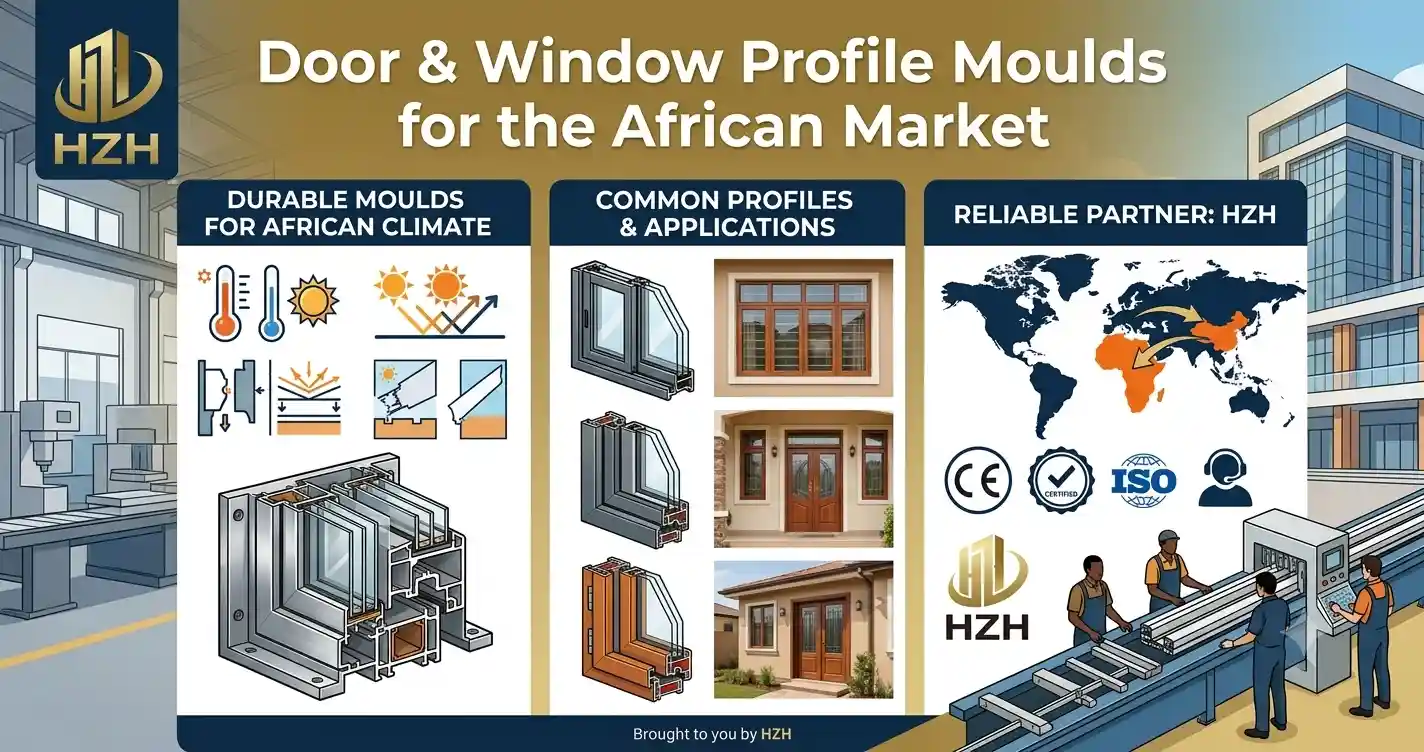
Lagos receives an average of 3,000 hours of sunlight annually. Nairobi sits at 1,795 metres above sea level with intense UV radiation year-round. Accra's coastal humidity regularly exceeds 85%. These are not abstract climate statistics — they are the daily operating conditions that every door and window profile manufactured for these markets must endure for 20 years or longer.
For building materials importers and local window manufacturers across Nigeria, Ghana, Kenya, and the broader sub-Saharan region, sourcing door and window profile moulds for the African market means navigating a specific set of priorities that differ meaningfully from European or Southeast Asian procurement decisions. Price matters — but so does whether the profiles the mould produces will still look and perform correctly in year five under equatorial UV exposure, and whether the Chinese supplier who sold you the tooling will still answer your calls when startup problems arise at 3 AM Lagos time.
This guide addresses both questions directly — with engineering specifics and practical sourcing guidance shaped for African market realities in 2026.
Why Africa's Construction Boom Is Creating Urgent Mould Demand Right Now
Sub-Saharan Africa is experiencing a structural housing and infrastructure expansion that is generating sustained, growing demand for locally manufactured door and window profiles — and by extension, for the extrusion tooling that produces them.
The Housing Deficit Driving Profile Demand
Nigeria alone faces a housing deficit estimated at 28 million units as of 2026, with the federal government's National Housing Programme targeting 500,000 new units annually through 2030. Ghana's housing shortfall exceeds 1.8 million units. Kenya's urban housing demand — concentrated in Nairobi, Mombasa, and secondary cities — is growing at approximately 200,000 units per year against supply that meets less than half that demand.
Each housing unit requires door and window frames. PVC profiles are increasingly specified over timber — driven by termite resistance, lower lifecycle maintenance cost, and the collapse of sustainable local timber supply chains across West and East Africa. This is not a trend. It is a structural market shift with a decade or more of momentum behind it.
The Local Manufacturing Advantage
Importing finished PVC profiles from China or Turkey into African markets carries significant cost drag: shipping weight, container utilisation inefficiency, import duties ranging from 10–25% across different African nations, and lead times of 45–75 days from order to port clearance. Local extrusion manufacturing with Chinese-sourced tooling eliminates most of these costs, compresses supply lead times to days rather than months, and enables profile customisation for local architectural preferences and hardware standards.
For building materials entrepreneurs and established importers considering the move from distribution to local manufacturing, the return on tooling investment in high-demand African markets is significantly faster than equivalent calculations for saturated European or North American markets.
The Tropical Climate Engineering Challenge: What African Markets Actually Need from a Mould
The most important technical question for any window profile mould for tropical climate application is not what the die looks like — it is what the profiles it produces do under sustained heat, UV radiation, and humidity exposure. Mould design directly determines this, through its effect on profile wall thickness consistency, surface quality, and co-extrusion cap layer integrity.
Heat Deformation Resistance: The Wall Thickness Factor
PVC window profiles in tropical climates reach surface temperatures of 65–80°C when dark-coloured or directly sun-exposed. At these temperatures, rigid PVC (uPVC) profiles approach their Vicat softening point — the temperature at which the material begins to lose dimensional stability. Profiles with inconsistent wall thickness — produced by a die with flow imbalance — show localised softening and deformation at thinner sections while thicker sections remain rigid.
This is not a material problem. It is a die engineering problem. A PVC window mould designed with precise flow channel balance produces consistent wall thickness throughout the profile cross-section — ensuring uniform heat resistance behaviour across the entire frame. In our 20+ years of mould engineering at Huazhiheng Mold, wall thickness variation beyond ±0.15 mm in tropical-market profiles consistently correlates with heat deformation complaints within the first two years of installation.
UV Stabilisation and Co-Extrusion Surface Engineering
Standard white uPVC formulations with basic titanium dioxide UV stabilisation are designed for temperate European climates receiving 1,200–1,600 hours of annual sunshine. Equatorial African markets receive 2,500–3,200 hours. The difference in UV dose over a 10-year service life is not incremental — it is transformational in terms of surface yellowing, chalking, and impact resistance reduction.
Two engineering approaches address this for African market profiles:
Enhanced UV stabiliser loading in the base PVC compound — increasing titanium dioxide content to 10–14 phr and adding HALS (Hindered Amine Light Stabiliser) to the formulation. This approach relies entirely on the compound chemistry and does not require mould modification
ASA co-extrusion cap layer — a 0.5–1.0 mm layer of Acrylonitrile Styrene Acrylate applied over the uPVC substrate through a co-extrusion die. ASA provides inherently superior UV resistance compared to pigmented uPVC, maintaining colour stability for 25+ years under tropical UV conditions. This approach requires a co-extrusion capable die and a secondary extruder on the production line
Humidity and Dimensional Stability
Coastal and equatorial markets — Lagos, Accra, Mombasa — combine high temperatures with sustained humidity that creates thermal cycling stress on window frame joints and gasket interfaces. Profile systems that use multi-chamber internal geometry perform significantly better under these conditions than single-cavity profiles, because the air-filled internal chambers provide thermal insulation that reduces temperature differential between the exterior and interior frame faces — limiting thermal gradient stress at corner welds and hardware engagement points.
An affordable profile extrusion die Africa that compromises on chamber geometry to reduce tooling cost produces profiles that may be dimensionally acceptable at manufacturing but develop corner joint cracking and gasket displacement within 3–5 years in high-humidity coastal environments. The mould specification that delivers lowest 10-year total cost of ownership is not always the one with the lowest day-one tooling price.
What Affordable Really Means for African Market Tooling
The word "affordable" in mould procurement carries significant risk when it means only "low initial price." For African market buyers evaluating affordable profile extrusion die Africa options, a more useful definition of affordability is lowest total cost per metre of saleable profile produced over a three-year production horizon.
The True Cost Calculation
| Cost Factor | Low-Price Unspecified Die | Quality-Specified Die |
|---|---|---|
| Initial tooling price | USD 800–1,200 | USD 1,800–2,800 |
| Correction rounds required | 3–5 rounds typical | 0–2 rounds typical |
| Correction freight cost | USD 600–1,200 total | USD 0–400 total |
| Startup scrap losses | High (2–4 weeks debugging) | Low (3–7 days debugging) |
| Service life (P20 nitrided) | 50–150 tonnes (45# steel) | 250–400 tonnes |
| Replacement frequency (3 years) | 2–4 replacements | 0–1 replacement |
| Estimated 3-year total cost | USD 4,000–7,000 | USD 2,200–3,600 |
The quality-specified die costs more on day one. Over three years of production, it consistently delivers lower total tooling cost — because it produces more metres of saleable profile before requiring replacement, generates less startup scrap, and eliminates the freight cost of repeated correction cycles between Africa and China.
The Right Specification Floor for African Market Production
For local window manufacturers targeting the Nigerian, Ghanaian, or Kenyan mid-market residential segment, these are the minimum specification requirements that deliver acceptable total cost of ownership:
Steel grade: P20 pre-hardened tool steel minimum — not 45# carbon steel
Surface treatment: Nitriding treatment mandatory for PVC corrosion resistance
Wall thickness tolerance: ±0.15 mm maximum variation across the profile cross-section
Chamber count: Minimum two internal chambers for profiles wider than 60 mm
Flow simulation: Supplier must confirm flow analysis was performed before machining
Documentation: Dimensional inspection report and material test certificate at delivery
Any supplier quoting significantly below market rates for a die meeting all of these specifications is almost certainly making a substitution somewhere — most commonly in steel grade or surface treatment. Request the material test certificate as a contractual delivery condition, not an optional add-on.
The After-Sales Support Question: What African Buyers Need to Demand
Distance and time zone differences make after-sales support the single most underestimated risk factor in Chinese mould sourcing for African buyers. A supplier who provides excellent pre-sale communication but disappears after shipping represents a serious operational risk for a window manufacturer in Lagos or Nairobi who encounters a startup problem with no local technical resource to call on.
What Structured After-Sales Support Looks Like
Professional PVC window mould export to Nigeria and broader African market transactions should include these support commitments in writing before order placement:
Remote debugging support via video call — covering the first production run, with a named engineer available during your startup window. Given West Africa's GMT+1 and East Africa's GMT+3 time zones, confirm that the supplier's engineering team provides support during your working hours — not only during Chinese business hours
Written process parameter recommendations — extruder temperature profile, screw speed, haul-off rate, and vacuum settings for your specific extruder model and PVC compound. Generic parameter sheets are not acceptable; parameters should be calculated for your equipment
Correction policy in writing — number of free correction rounds covered, shipping cost responsibility for each round, and response lead time if corrections are needed
Spare insert availability — confirmation that replaceable wear components (die lip inserts, mandrel tips) are held in stock and can be dispatched within 5–7 days of a service request
The Logistics Reality: Getting Moulds to African Markets
Practical logistics planning is as important as technical specification for African market tooling procurement. Key considerations for importers in Nigeria, Ghana, and Kenya:
Air freight for urgent orders: A standard single-cavity PVC window profile die weighs 15–35 kg. Air freight from central China to Lagos (LOS), Accra (ACC), or Nairobi (NBO) via major cargo hubs typically costs USD 280–480 per die set with 5–8 business day transit. For production-critical orders, this cost is justified by the weeks saved versus sea freight
Sea freight for volume orders: Full or consolidated container shipments via Shanghai, Ningbo, or Guangzhou to Apapa (Lagos), Tema (Accra), or Mombasa typically transit in 28–42 days. Suitable for planned tooling programmes where timeline allows
Export packaging standards: Moulds shipped to African ports require robust wooden crate packaging with internal foam protection, rust-prevention VCI film wrapping, and clear customs documentation. Confirm these packaging standards with your supplier — inadequate packaging through tropical port environments causes corrosion damage that voids warranty claims
Import duty classification: Extrusion moulds typically classify under HS Code 8480 (moulds for rubber or plastics) — verify the applicable import duty rate in your country before finalising landed cost calculations, as rates vary from 5% (Kenya EAC common external tariff) to 20% (Nigeria) for this category
Sourcing door and window profile moulds for your African manufacturing operation?
Huazhiheng Mold provides tropical-climate optimised PVC profile die engineering, written after-sales support commitments, air and sea freight export capability from Ezhou Huahu International Logistics Airport, and 20+ years of extrusion expertise — backed by ISO 9001 and IATF 16949 certification.
Request a Free African Market Mould Consultation →Choosing the Right Entry-Level Mould Programme for African Market Startups
For entrepreneurs and importers launching their first local PVC window profile manufacturing operation in Nigeria, Ghana, or Kenya, a structured entry-level tooling programme reduces startup risk without sacrificing the quality floor that tropical climate performance requires.
Recommended Starter Profile Family
A viable market-entry mould programme for African residential window production typically covers four to six profile types that address the highest-volume product categories:
60mm or 65mm main window frame profile — the highest-volume single profile in any residential window system
Matching sash profile — co-engineered with the frame die for correct interlock fit
Glazing bead (two sizes) — for single and double glazing applications
Sliding track profile — sliding windows dominate African residential construction over casement for cost and ventilation reasons
Door frame profile — mid-to-high demand across Nigerian and Ghanaian urban housing segments
This five-to-six die starter programme can be produced and delivered in 30–40 days for a single-cavity configuration, covers the product range needed to address the majority of residential construction demand, and represents a total tooling investment of USD 9,000–16,000 depending on profile complexity and specification level — a capital commitment with typical payback measured in months rather than years in high-demand urban African markets.
Key Takeaways
Africa's construction boom is structural, not cyclical — Nigeria's 28-million-unit housing deficit, Ghana's and Kenya's sustained urban growth, and the regional shift from timber to PVC profiles create a decade-long demand runway that justifies local manufacturing investment now
Tropical climate performance is an engineering specification, not a material choice — wall thickness consistency from flow-balanced die design, multi-chamber internal geometry, and UV-resistant formulation or ASA co-extrusion are the specific technical requirements that determine whether profiles survive 10 years of equatorial sun and coastal humidity
Written after-sales support commitments are non-negotiable — remote debugging coverage during African business hours, written process parameters for your specific equipment, and documented correction round policies protect your production startup investment across the distance and time zone gap between China and sub-Saharan Africa
The African door and window profile market in 2026 is at an inflection point where local manufacturing is transitioning from early-adopter advantage to mainstream competitive necessity. Building materials entrepreneurs and established importers who establish reliable tooling supply chains and local production capability now will hold structural cost and lead time advantages over import-dependent competitors — advantages that compound as construction volumes grow and import cost pressures intensify through the decade.
Ready to build a local PVC window profile manufacturing capability for your African market?
Huazhiheng Mold's engineering team provides complete support for African market tooling programmes — from tropical-climate die specification and starter profile family planning through export packaging, logistics coordination, and remote production startup support in your time zone.
Start Your African Market Tooling Programme →Frequently Asked Questions
What makes a PVC window profile mould suitable for tropical African climates?
A mould suitable for tropical African market production must achieve precise flow balance across the profile cross-section to ensure consistent wall thickness throughout — this directly determines heat deformation resistance at 65–80°C surface temperatures common in equatorial climates. Multi-chamber internal profile geometry reduces thermal gradient stress. For UV performance, the die should be capable of co-extrusion with ASA cap layers for premium applications, or be designed for enhanced UV stabiliser loading in the base compound for standard residential production.
Is it worth investing in local PVC window profile manufacturing in Nigeria or Ghana in 2026?
Yes — market fundamentals strongly support local manufacturing investment. Nigeria's 28-million-unit housing deficit, Ghana's 1.8-million-unit shortfall, and import duty rates of 10–20% on finished profiles create a cost and supply chain advantage for local manufacturers that typically delivers tooling investment payback within 12–24 months at realistic production volumes. The African PVC window market is projected at 7.2% CAGR through 2030, providing sustained demand growth for well-positioned local producers.
How do I get after-sales support from a Chinese mould supplier when I'm in Nigeria or Kenya?
Before placing any order, confirm in writing that the supplier provides remote debugging support via video call during your local business hours — West Africa GMT+1 and East Africa GMT+3. Require written process parameter sheets calculated for your specific extruder model and PVC compound. Document correction round terms, shipping cost responsibility, and response lead times in your purchase order. Suppliers who resist written support commitments should be treated as a high after-sales risk regardless of their pre-sale communication quality.
What is the typical cost of a starter mould programme for African window production?
A five-to-six die starter programme covering main frame, sash, glazing bead, sliding track, and door frame profiles — specified to P20 nitrided tool steel with flow simulation and dimensional inspection — typically costs USD 9,000–16,000 depending on profile complexity and cavity count. This investment covers the core product range for Nigerian, Ghanaian, or Kenyan residential construction demand and typically delivers payback within 12–18 months at moderate production volumes in high-demand urban markets.
What import duties apply to extrusion moulds imported into Nigeria, Ghana, or Kenya?
Extrusion moulds typically classify under HS Code 8480 (moulds for rubber or plastics). Applicable import duty rates vary by country: Kenya applies a 0–10% rate under EAC common external tariff provisions for capital equipment; Ghana applies approximately 10–20% depending on classification; Nigeria applies up to 20% for this category. Always verify current rates with a licensed customs broker in your country before finalising landed cost calculations, as rates and classification rules are subject to change under periodic tariff reviews.