


How to Choose a Door & Window Profile Mould 2026
2026-05-29 23:52How to Choose a Door and Window Profile Mould: The Complete 2026 Buyer's Guide for First-Time Purchasers
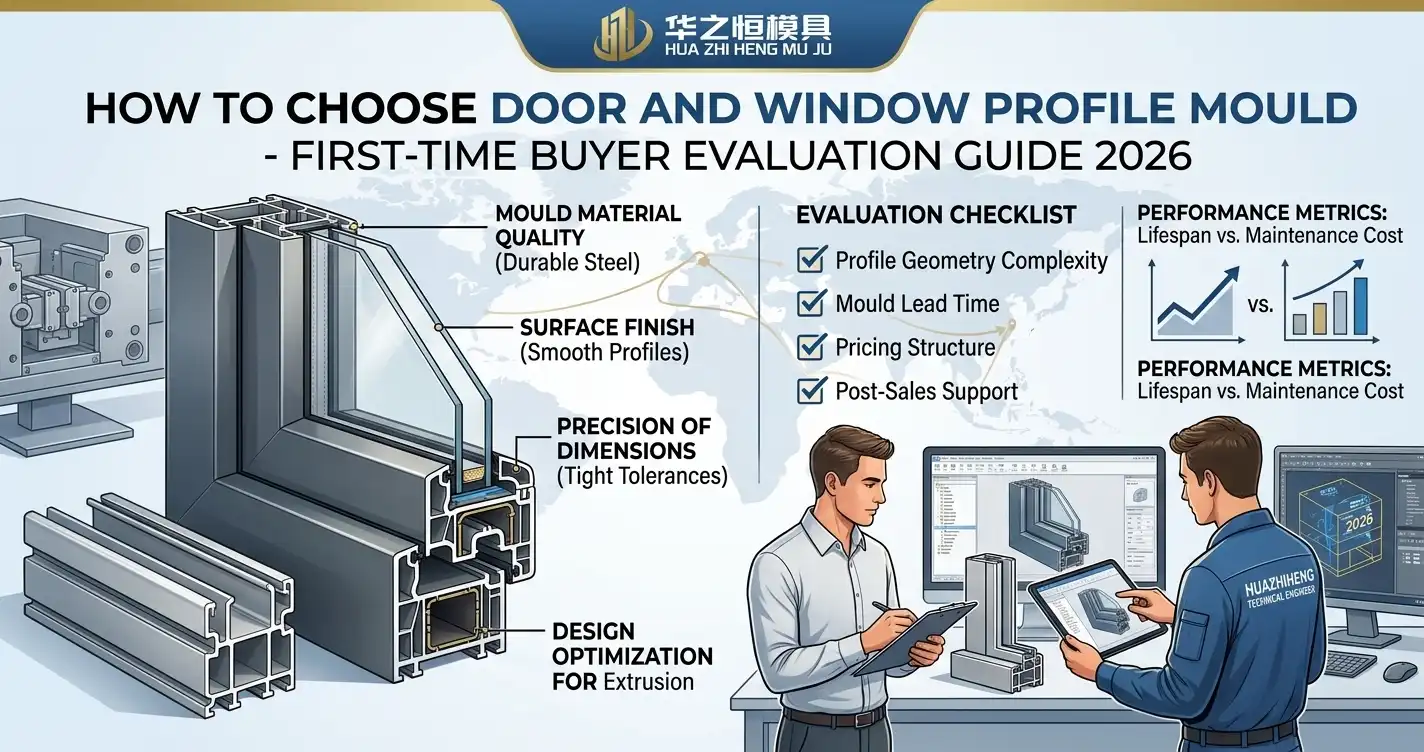
Your first extrusion mould purchase will shape every metre of profile your production line makes — for the next five to ten years. Get it right, and you start production on schedule, hit your dimensional targets from day one, and build a profitable product line. Get it wrong, and you face correction rounds, delayed startups, scrap losses, and a supplier relationship defined by disputes rather than support.
The problem is that most first-time door and window profile mould buyers do not know what they do not know. Profile drawings get sent to three or four suppliers. The lowest quote wins. And then the problems begin.
This guide changes that. Whether you are launching a PVC window profile line, entering the WPC door frame market, or expanding into aluminium extrusion, these are the exact criteria, questions, and standards that experienced procurement professionals use to evaluate tooling suppliers — explained clearly for buyers making this decision for the first time in 2026.
Start Here: Understand What You Are Actually Buying
A door or window profile extrusion mould is not a commodity purchase. It is a precision engineering project — one where the tooling is custom-designed for your specific profile geometry, your specific extrusion press, and your specific material formulation. No two mould projects are identical, even for visually similar profiles.
This matters because it changes how you should evaluate suppliers. You are not comparing standard products at different price points. You are evaluating an engineering partner's capability to solve a specific technical problem for your production context.
Step 1: Define Your Requirements Before Contacting Any Supplier
The single most effective thing a first-time buyer can do is arrive at supplier conversations with complete technical documentation. Suppliers who receive complete specifications produce better quotes, more accurate lead times, and fewer surprises after order placement.
The Minimum Documentation Package
Before sending a single enquiry, prepare the following:
Profile cross-section drawing — DXF or DWG format, with all critical dimensions and tolerances marked. If you only have a sample profile, most experienced suppliers can produce reverse-engineering drawings — but confirm this capability upfront
Material specification — PVC (rigid or flexible), UPVC, WPC (HDPE-based or PVC-based), or aluminium alloy grade. Each material requires fundamentally different die engineering
Extruder model and screw diameter — The die must be compatible with your press output characteristics. A die engineered for an SJZ65/132 twin-screw extruder will not perform correctly on an SJZ80/156
Target production speed — Metres per minute at your operating conditions. This affects bearing length calculations throughout the die design
Required cavity count — Single-cavity (one profile per cycle) or multi-cavity (two or more profiles simultaneously)
Annual production volume estimate — This determines the required service life and appropriate steel specification
Suppliers who receive this information produce better proposals meaningfully. Those who quote without it are estimating — and their estimates may not reflect your actual production requirements.
Step 2: Understand Mould Steel Grades — This Is Where Quality Lives
The steel specification of your extrusion mould determines its dimensional stability, surface quality, and service life. It is also the specification most frequently downgraded by cost-cutting suppliers without the buyer's knowledge.
The Three Steel Tiers You Will Encounter
| Steel Grade | Typical Application | Service Life | Surface Treatment |
|---|---|---|---|
| H13 Hot-Work Tool Steel | Aluminium extrusion, high-volume PVC | 400–700+ tonnes | Nitriding + vacuum hardening |
| P20 / 718 Pre-hardened Steel | Standard PVC, WPC medium volume | 200–400 tonnes | Nitriding standard |
| 45# Carbon Steel | Low-volume trial dies only | 50–150 tonnes | Basic hardening only |
For most commercial door and window profile production, P20 with nitriding treatment is the minimum acceptable specification for PVC and WPC applications. H13 with vacuum hardening and nitriding is the appropriate choice for high-volume production lines running more than 250 days per year, and is the mandatory standard for aluminium extrusion dies.
Why Nitriding Treatment Matters
Nitriding is a surface hardening process that diffuses nitrogen into the outer 0.2–0.5 mm of the die steel, creating a surface layer with a hardness of 900–1,050 HV. For PVC extrusion, nitriding provides critical resistance to the corrosive hydrogen chloride gas that PVC releases during processing. For WPC, it resists the abrasive action of wood fibre particles on flow channel surfaces.
A die without nitriding treatment in a PVC or WPC application will show measurable surface degradation — affecting profile finish quality — within 50–100 tonnes of production. A nitrided die maintains surface quality for 300–500+ tonnes under the same conditions.
Step 3: Evaluate the Supplier's Engineering Process — Not Just Their Price
Price comparison is the least useful evaluation tool for first-time mould buyers. Two quotes at different prices may represent entirely different engineering approaches, steel specifications, and service commitments. These five process indicators reveal far more about supplier quality than the bottom-line number.
1. Do They Ask Technical Questions Before Quoting?
A professional extrusion mould supplier cannot produce an accurate quote without knowing your extruder model, material specification, and production speed requirements. If a supplier provides a detailed quote within hours of receiving only a profile drawing — with no follow-up questions — they are not engineering a custom die. They are pricing a generic approximation.
In our 20+ years of mould manufacturing at HZH Mould, the enquiries that result in the most successful projects are always those where the buyer has prepared complete technical data and the supplier's first response is a list of clarifying questions — not an immediate price.
2. Do They Provide Flow Simulation Analysis?
Modern extrusion die design uses CAD/CAM software with integrated flow simulation to model how molten material behaves inside the die before any steel is cut. Suppliers who use simulation identify flow imbalances, pressure distribution problems, and dead zones digitally — where corrections cost nothing.
Suppliers who skip simulation discover the same problems during physical trials — where corrections cost time, freight, and money. For a first-time buyer, this difference directly determines whether your startup goes smoothly or turns into a weeks-long debugging exercise.
3. What Certifications Do They Hold?
Quality management certifications provide verifiable evidence of process discipline. The two most relevant for profile mould quality standards evaluation are:
ISO 9001 — Documents the quality management framework from customer requirement capture through final delivery inspection
IATF 16949 — Originally developed for automotive supply chains, this standard requires statistical process control, capability studies, and rigorous corrective action procedures that directly translate to dimensional consistency in mould manufacturing
Request current certificate copies and verify the certification body and expiry date. Certifications should be from accredited third-party bodies — not self-issued quality declarations.
4. What Does Their After-Sales Support Cover?
The mould leaving the factory is not the end of the project — it is the halfway point. The first production run on your extrusion line will require parameter adjustment, vacuum calibration setup, and potentially minor die corrections. How your supplier handles this phase determines whether your startup takes one week or two months.
Confirm in writing before ordering:
How many free correction rounds are included if the die does not meet specified tolerances
Whether remote debugging support (video call guidance) is available during your first production run
What the warranty period covers and what triggers a warranty claim versus a chargeable service
Lead time for correction of die components if modifications are required after initial trials
5. Can They Provide Reference Projects?
Experienced suppliers have a portfolio of completed mould projects for similar profile types. Request non-confidential examples of window or door profile moulds they have manufactured for comparable applications — ideally with profile cross-section photos, dimensional inspection results, or customer references. A factory that cannot provide any project evidence for the profile type you are ordering carries meaningful delivery risk.
Step 4: Apply the 7-Question Checklist Before Placing Any Order
Use these seven questions as your final qualification gate. A capable supplier should answer all seven specifically and in writing.
"What steel grade and surface treatment will you use for this die — and can you provide the material test certificate at delivery?"
"Do you perform flow simulation analysis before machining? Can you share the simulation report as part of the project deliverables?"
"What is your average number of correction rounds for this type of profile die?"
"What quality certifications do you hold, and can you send copies now?"
"What dimensional inspection reports will accompany the die at delivery?"
"What after-sales support do you provide during my first production run, and what are the terms for free corrections if tolerances are not met?"
"What is your realistic lead time from drawing approval to dispatch — including all machining, heat treatment, and inspection stages?"
Not sure where to start with your first mould enquiry?
HZH Mould's engineering team guides first-time buyers through the complete specification process — from profile drawing review and extruder compatibility check through steel selection, lead time planning, and after-sales debugging support.
Get a Free First-Buyer Consultation →Step 5: Understand the Total Cost — Beyond the Mould Price
First-time buyers frequently optimise for unit mould price and discover later that the true cost of a poor-quality die significantly exceeds the savings made at purchase. These four cost factors complete the picture.
Correction Round Freight Costs
If a die requires correction after initial trials, it must be shipped back to the manufacturer — and then returned to you. For an international supply chain, a single correction round adds USD 300–800 in freight costs and 10–20 days to your startup timeline. A specification-complete order placed with a simulation-capable supplier typically requires zero to two correction rounds. A poorly specified order with a non-simulation supplier can require four to six — erasing all initial price savings.
Scrap Production During Debugging
Every hour your extrusion line runs an out-of-specification profile during debugging generates scrap material cost and lost production capacity. For a line running 200 kg/hour of PVC compound at USD 1.20–1.50/kg, a two-week debugging delay represents USD 6,000–10,000 in direct scrap and opportunity cost — often multiples of the mould price difference between a cheap and a quality die.
Mould Replacement Frequency
An underspecified die using 45# carbon steel may require replacement after 100–150 tonnes of production. A correctly specified H13 nitrided die for the same application may last 500–700 tonnes. Over a five-year production horizon, mould replacement frequency can mean the difference between one tooling investment and four, at total cost multiples that dwarf any initial unit price saving.
Key Takeaways
Prepare complete technical documentation before approaching any supplier — extruder model, material specification, profile drawing with tolerances, production speed, and volume targets. This single step eliminates the most common first-buyer mistakes
Steel grade and surface treatment are the most critical quality variables in mould selection — verify H13 or P20 specification with material test certificates, and require nitriding treatment as a contractual minimum for any commercial production application
Evaluate the engineering process, not just the price — a supplier who asks technical questions, provides flow simulation analysis, holds ISO 9001 and IATF 16949 certifications, and offers documented after-sales support will cost less over the lifetime of your production program than the cheapest quote on your comparison sheet
Every experienced mould buyer was once a first-time buyer. The difference between a smooth market entry and a costly startup delay almost always comes down to preparation and supplier qualification — not luck. In 2026's competitive door and window profile market, the manufacturers who get tooling right from the first order build production advantages that compound over the years.
Ready to place your first door or window profile mould order with confidence?
HZH Mould provides 20+ years of extrusion mould expertise, ISO 9001 & IATF 16949 certified manufacturing, flow simulation analysis, H13 and P20 steel with nitriding treatment, CMM dimensional inspection, and full debugging support — the complete package for first-time and experienced buyers alike.
Start Your Mould Project Today →Frequently Asked Questions
What is the most important factor when choosing a door and window profile mould?
Steel grade and surface treatment specification are the single most impactful factors for long-term mould performance. H13 hot-work tool steel with vacuum hardening and nitriding treatment delivers 3–5 times longer service life than carbon steel alternatives under equivalent production conditions. Beyond materials, the supplier's use of flow simulation analysis before machining is the strongest predictor of first-run dimensional accuracy and low correction round frequency.
How long should a door and window profile mould last?
Service life depends on steel specification, surface treatment, material processed, and production intensity. A correctly specified P20 nitrided die for PVC window profiles typically lasts 200–400 tonnes of extruded material. An H13 vacuum-hardened and nitrided die for the same application lasts 400–700+ tonnes. For aluminium extrusion dies, nitrided H13 achieves 400–600 tonnes under standard production conditions. Annual production volume determines which specification tier is economically justified.
What information do I need to provide to get an accurate mould quote?
Provide your profile cross-section drawing in DXF or DWG format with dimensional tolerances marked, your extruder model and screw diameter, the material you will extrude (PVC, UPVC, WPC, or aluminium alloy grade), your target production speed in metres per minute, whether you need single or multi-cavity tooling, and your estimated annual production volume. Suppliers who receive this data produce significantly more accurate quotes with fewer post-order surprises.
What does mould debugging support mean and why does it matter?
Debugging support refers to technical assistance provided by the mould manufacturer during your first production run — covering extrusion parameter optimisation, vacuum calibration setup, and die corrections if dimensional targets are not met immediately. It matters because approximately 60% of startup quality issues relate to process parameters rather than mould defects, and an inexperienced production team cannot always distinguish between the two without supplier guidance. Confirm the scope of debugging support in writing before placing your order.
Is it safe to buy door and window profile moulds from China as a first-time buyer?
Yes, with proper supplier qualification. China-based mould manufacturers holding ISO 9001 and IATF 16949 certifications, operating precision CNC and EDM equipment, and providing documented quality inspection reports are capable of producing profile moulds that meet international dimensional standards. The risk is not country of origin — it is insufficient supplier qualification. The checklist and questions in this guide provide the evaluation framework to identify capable manufacturers regardless of location.